
When AI agents can build and operate software autonomously, which enterprise moats survive?
From Flo's AI Lab
I shipped an enterprise AI avatar this week. Concept to production in 5 days, no traditional development team. The interesting part wasn't the speed. It was the governance: 5 parallel AI agents ran a security review (architecture, performance, patterns, simplicity) before the client saw a demo. Enterprise clients always ask the same question first: not "how fast" but "how do you control it."
I also hosted the Munich Claude Code Meetup under the title "4 Products. 0 Developers." That's becoming less of a provocation and more of a planning assumption.
This week, Andrej Karpathy killed a term he created. That matters less than the business question behind it: when AI agents can build and operate software autonomously, which enterprise moats survive and which don't?
Where the Moats Actually Are
When Karpathy declared vibe coding dead on February 4 and replaced it with "agentic engineering," most of the tech press treated it as branding. It's worth taking more seriously. The shift from conversational AI prototyping to autonomous, goal-driven AI agents changes the cost structure of enterprise software. But it doesn't change it the way most commentary suggests.
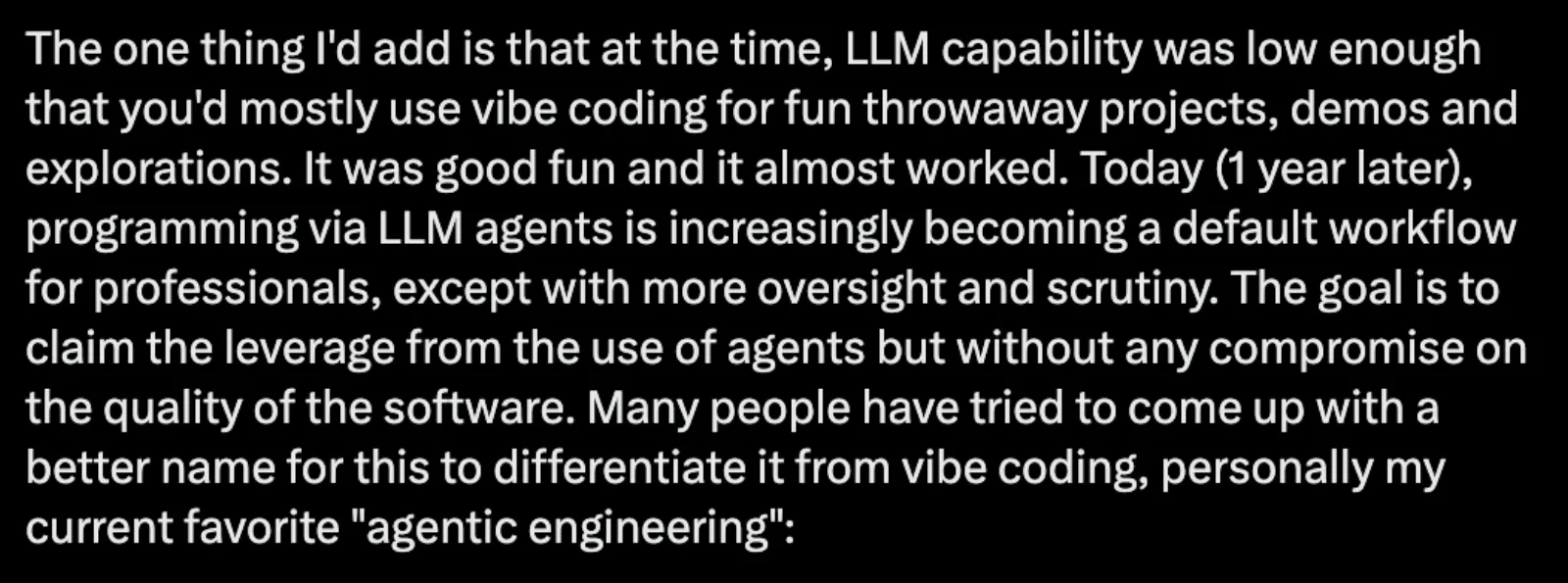 Karpathy's X post on agentic engineering — the term he coined to replace "vibe coding."
The common narrative: AI agents will commoditize SaaS, switching costs will collapse, and every vendor charging per-seat is doomed. That's partially right and mostly misleading. Here's why.
Hal Varian and Carl Shapiro identified multiple sources of lock-in in "Information Rules" (1999): switching costs from retraining, data formats and migration complexity, network effects within ecosystems, and installed-base dynamics where value accumulates over time. Enterprise SaaS leverages all four. The question isn't whether agentic engineering attacks switching costs. It does. The question is which ones.
What agents erode: UI and training lock-in. When an AI can learn a new tool in minutes, the argument "our team already knows Salesforce" weakens. When agents operate via APIs rather than dashboards, interface design stops being a differentiator. Spotify just demonstrated this (TechCrunch, Feb 12): engineers instruct Claude Code via Slack, and updated code arrives before the next standup. Their top developers haven't written a line of code manually since December. The UI layer is becoming optional for technical workflows.
What agents don't touch (yet): Data gravity. Your CRM holds 8 years of customer interactions, pipeline history, and forecasting models. An agent can't migrate that overnight, and the compliance risk of trying is real. Integration debt is the other silent moat: enterprise APIs are often a decade old, poorly documented, and deeply coupled with internal processes. These moats are real, and they buy incumbents time.
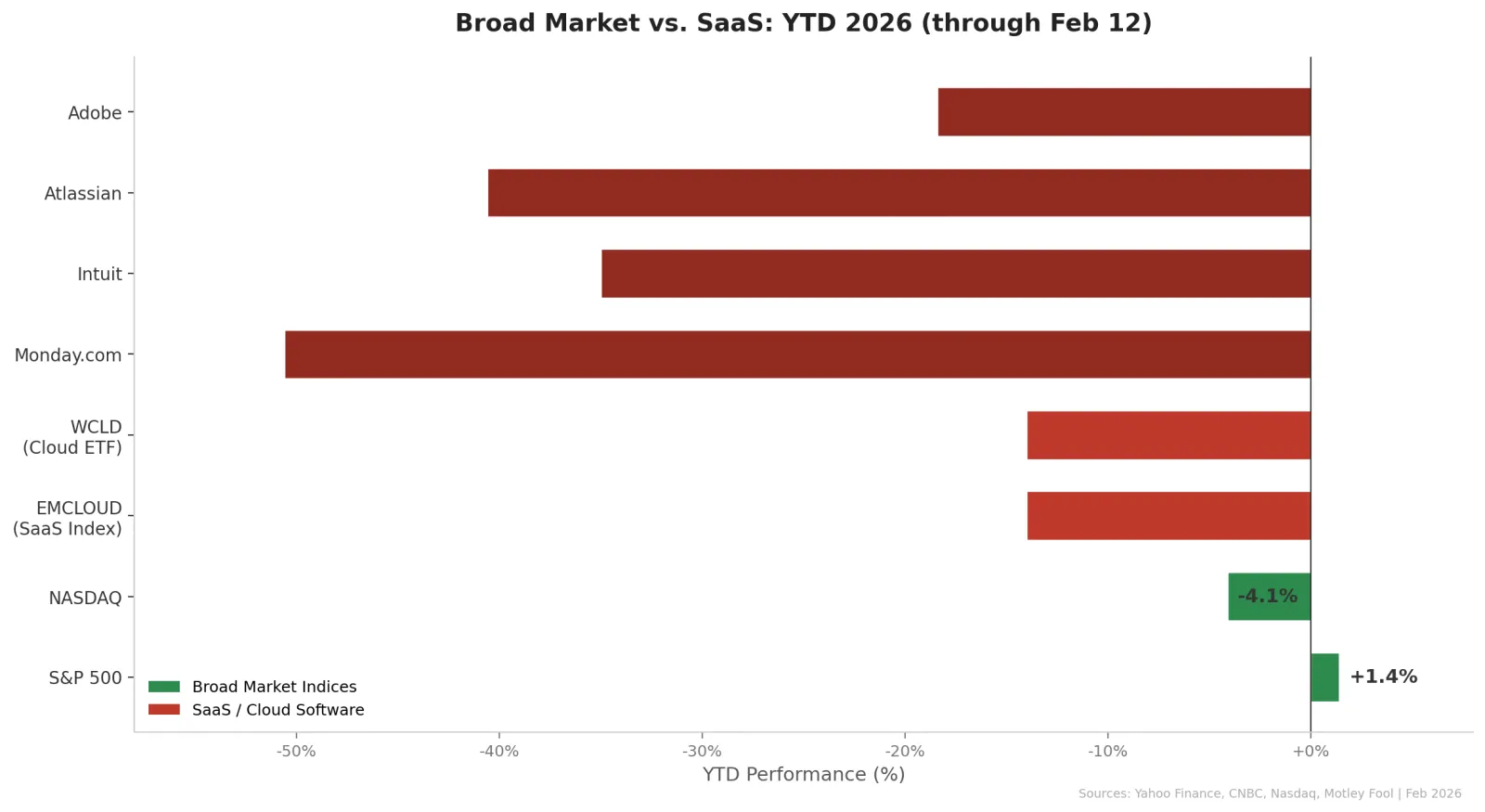 S&P 500 gained 1.4% while SaaS stocks lost 14–51%. The sell-off was targeted, not macro.
But here's the deeper shift most analysts are missing. The switching cost debate focuses on existing software. The more disruptive question is about software that hasn't been built yet.
Every make-or-buy decision in enterprise software comes down to one question: is it cheaper to build what I need, or to buy something generic and adapt it? For two decades, the answer was obvious. Building was expensive, slow, and risky. So companies bought horizontal platforms (SAP, Salesforce, Monday.com) and spent months customizing a one-size-fits-all product. The cost of building was simply too high.
Agentic engineering is collapsing that ratio. When a company can have AI agents build a purpose-fit CRM or a small ERP system in weeks rather than months, at a fraction of the cost of enterprise licenses, the economic rationale for the horizontal platform weakens. Not for everyone, and not overnight. But the direction is clear: more specialization. Industry-specific standard software for manufacturing verticals. Country-specific compliance tools. Niche solutions designed for 500 companies, not 500,000.
The billion-dollar horizontal platforms won't vanish next quarter. But the barrier that kept new entrants out (the sheer cost of building enterprise-grade software) is eroding. The conditions for a wave of specialized alternatives are forming. For every SAP module that takes 18 months to customize, there's now a realistic possibility that a purpose-built alternative gets built, tested, and deployed in a single quarter.
What agents create as a new moat: The companies controlling the agent infrastructure layer are building the next generation of lock-in. Anthropic is raising $20 billion (TechCrunch, Feb 9), with Nvidia and Microsoft each writing checks above $1 billion. That's a bet on owning the orchestration layer between enterprises and their entire software stack. If your agents run on one platform and your workflows depend on that platform's capabilities, you've traded one lock-in for another.
Lock-in doesn't disappear. It migrates. The vendor you should worry about isn't the one you're paying per-seat today. It's the one whose agent layer is quietly becoming your new operating system.
The data supports a measured read. 35% of organizations report broad AI agent usage, but only 8.6% have agents in production (Deloitte, State of AI in the Enterprise 2026). The gap between experimenting and deploying is where the value sits, and where the risk sits for anyone moving too fast without governance.
The implication for executives: Audit your SaaS stack, but ask two questions. First: where does this vendor's lock-in actually come from? If it's UI familiarity, that contract is a renegotiation opportunity within 12-18 months. If it's proprietary data or regulatory compliance, that vendor is likely strengthening. Second, and this is the one most boards aren't asking yet: could a purpose-built alternative, developed with agentic engineering, serve our specific needs better and cheaper than the horizontal platform we're customizing today? If the answer is even "maybe," it's time to run a proof of concept.
The bigger risk is doing nothing. If you run a mid-market software company and your development process hasn't changed in the past 12 months, consider what that means: fewer iterations than your competitors, slower time to market, legacy code and legacy languages that accumulate technical debt instead of resolving it. Features your customers have requested for years stay on the backlog because the cost and time were always too high. With agentic engineering, those features become buildable. The technical debt becomes addressable. The companies that adopt this mindset don't just get incrementally faster. They break out of the constraints that traditional software development imposed, and they start running at a pace their competitors can't match by hiring alone.
For PE and fund managers: The $285 billion that vanished from SaaS stocks in a single trading session (CNBC, Feb 6) wasn't macro. If it were, the broader market would have suffered equally. It didn't. The losses were concentrated in companies directly exposed to the capabilities that Anthropic and OpenAI released. When Anthropic published its Skills framework (which are, in essence, structured text files anyone can replicate), companies that had been selling similar capabilities as proprietary software lost value overnight. The market is learning to distinguish between software moats built on data and integration depth and those built on functionality that AI agents can now replicate. For portfolio evaluation, the question is straightforward: does this company's product do something an AI agent can't, or does it just do it with a nicer interface?
If this analysis changed how you think about one vendor contract or one portfolio position, forward it to a colleague facing the same question.
Want to explore how agentic engineering can strengthen your competitive position? Visit /angebote.