Der Auftrag
Am 23. April war ich gemeinsam mit Oliver Gerstheimer von der Kasseler Design-Agentur chilli mind Gastdozent an der Universität St. Gallen, im CAS Management für IT-Führungskräfte (CAS MITF 2026). Vier Stunden, rund 17 Schweizer IT-Heads und CIOs, ein gemeinsames Versprechen: keine Folienschlacht, sondern Praxis.
Der Versprechen-Satz auf unserer Titelfolie war bewusst provokant:
"Was eine Agentur früher in Wochen schaffte, macht heute eine Person am Nachmittag."
Die Frage war nicht, ob das stimmt. Die Frage war, ob die Teilnehmer es selbst sehen wollen.
Drei Modi der AI-Arbeit
Bevor wir die Hände an die Tastatur legen, muss klar sein, in welcher Tiefe wir arbeiten. Wir haben das im Vortrag in drei Modi unterteilt, weil die meisten Führungskräfte nur den ersten kennen:
| Modus | Analogie | Typische Nutzung |
|---|---|---|
| Claude Chat | Praktikant, der neben Ihnen sitzt | Texte entwerfen, Ideen challengen |
| Claude Cowork | Kollege mit Zugang zu Ihrem Projektordner | Dokumente bauen, Research, Projektarbeit |
| Claude Code | Senior-Engineer im Maschinenraum | Automatisierungen, Skills, ganze Pipelines |
Die meisten im Raum hatten Erfahrung mit ChatGPT. Niemand hatte je einen AI-Kollegen erlebt, der Zugriff auf einen Projektordner hat, Dateien versteht, eigenständig Fragen stellt und am Ende ein Artefakt abliefert, das man durch die nächste Compliance-Runde schicken kann.
Die Case Study: Novela
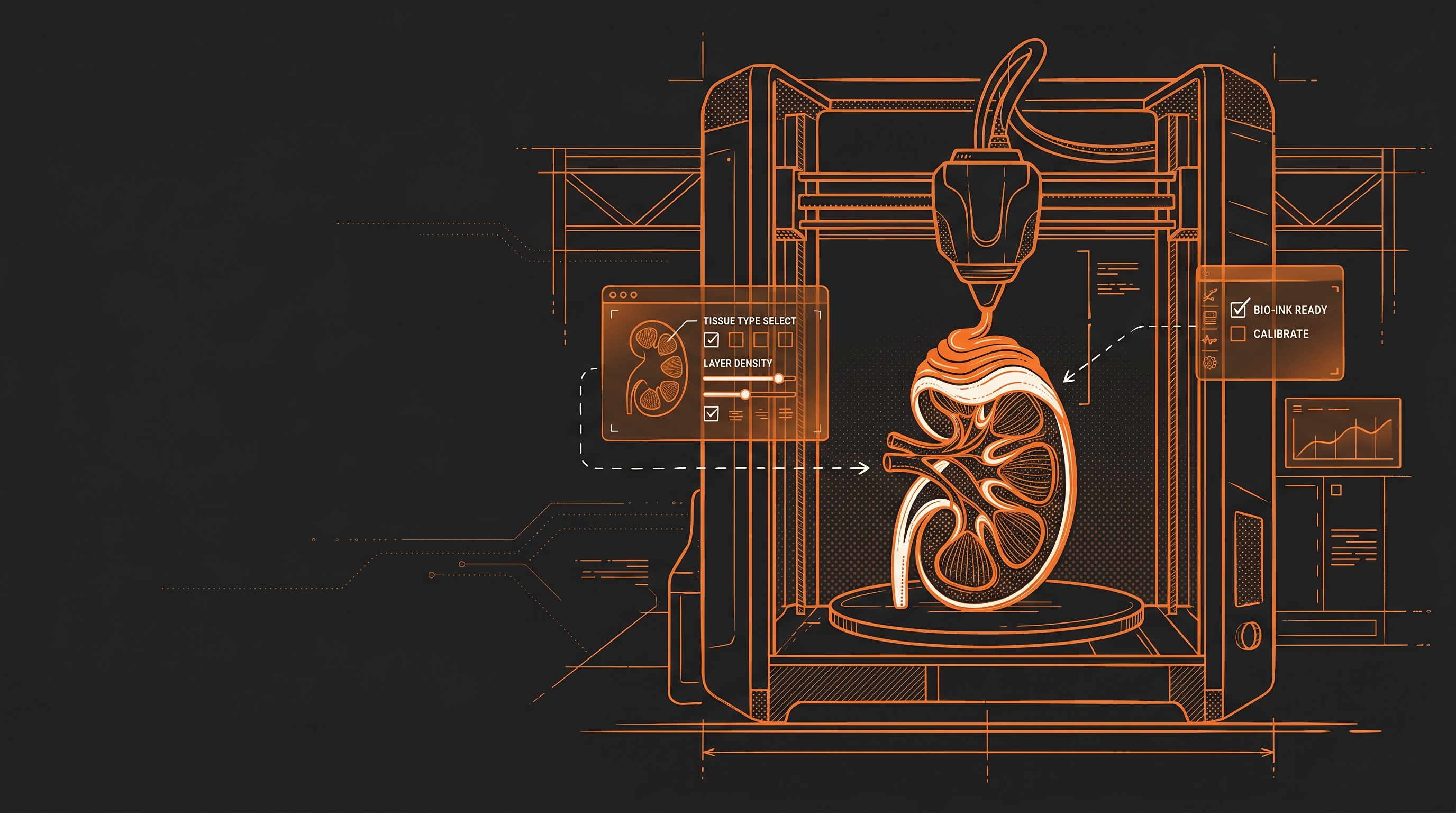
Die HSG hatte uns einen fiktiven Case mitgegeben. Zwei Schweizer Medizintechnik-Riesen, Doche und Blaukreuz, fusionieren zur Novela AG. 200 Milliarden Franken Umsatz, 200.000 Mitarbeitende, Hauptsitz Schweiz, F&E in Europa, USA und Japan. Die spektakuläre Produktinnovation: ein 3D-Bioprinter für Nierengewebe, weil zehn Prozent der Weltbevölkerung von chronischer Nierenerkrankung betroffen sind und Millionen jedes Jahr ohne erschwingliche Behandlung sterben.
Die Case Study der HSG war eine halbe DIN-A4-Seite. Mehr nicht. Genau richtig, um zu zeigen, was passiert, wenn man eine Idee an einen guten AI-Kollegen übergibt.
Was in vier Stunden entstanden ist
Wir haben mit den Teilnehmern Schritt für Schritt durchgearbeitet, was passiert, wenn man Claude Code als Senior-Engineer behandelt und ihm einen sauberen Auftrag gibt. Die Reihenfolge:
- Intake-Interview mit Claude Code im Terminal - Claude stellt Rückfragen zu Zielgruppe, Ticket-Größe, regulatorischem Umfeld, Systemlandschaft.
- PRD-Generierung in einem Rutsch - Executive Summary, Personas, funktionale Anforderungen, nicht-funktionale Anforderungen, technische Architektur, User Stories, Erfolgsmetriken, Risiken, Timeline.
- Mockups & Visualisierung - parallel dazu erste Wizard-Screens des Konfigurators als visuelle Anker.
Das Ergebnis war ein 8-seitiges PRD für den Nierendrucker-Konfigurator - eine webbasierte Self-Service-Lösung, mit der Pharma-R&D, Universitätskliniken und CROs in unter zehn Minuten ihre Konfiguration bauen, ein verbindliches PDF-Angebot bekommen und automatisch als qualifizierter Lead im CRM landen.
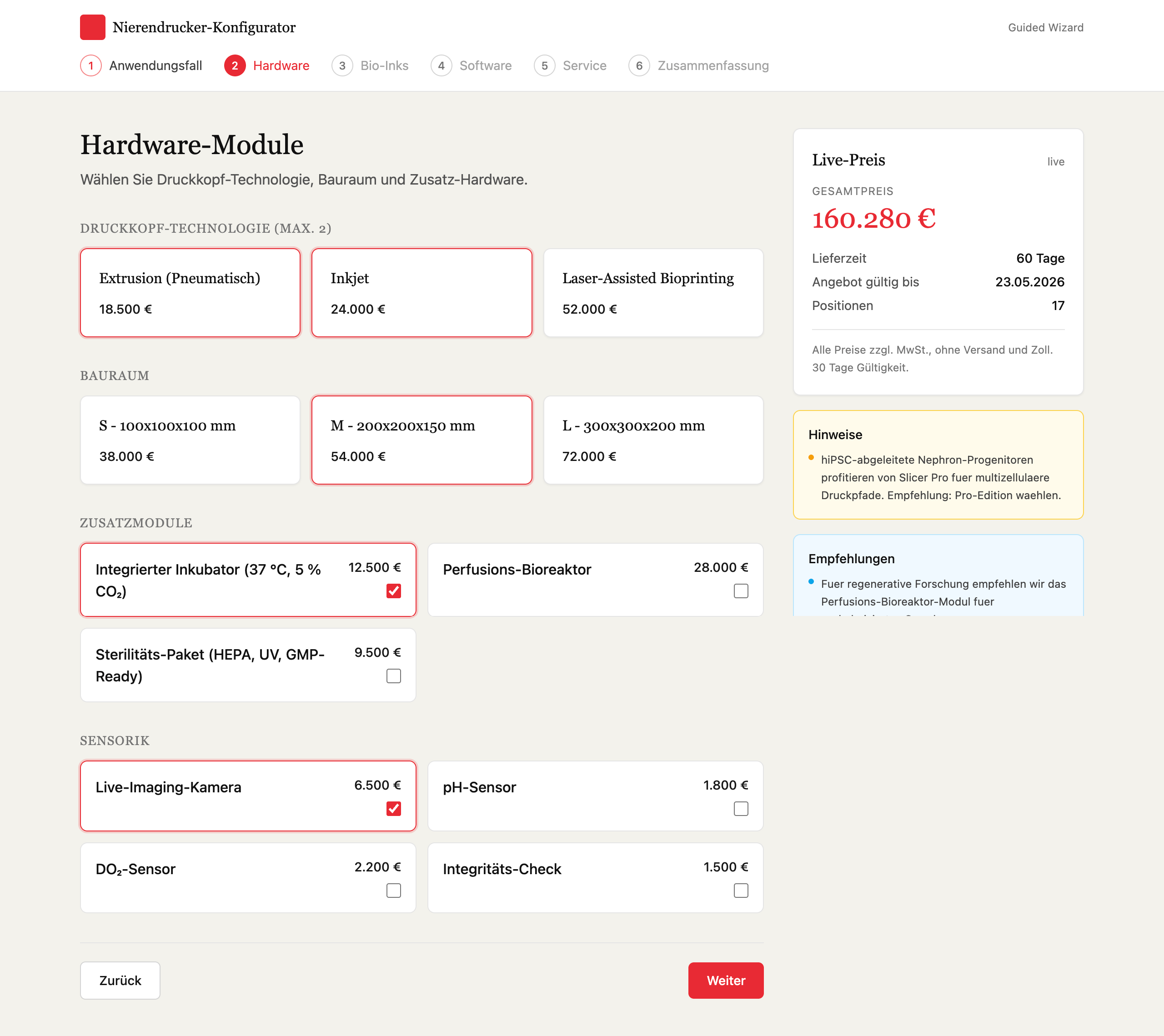 Hardware-Schritt: Druckkopf-Technologie, Bauraum, Sensorik. Live-Preis rechts, Empfehlungen abhängig vom gewählten Use-Case.
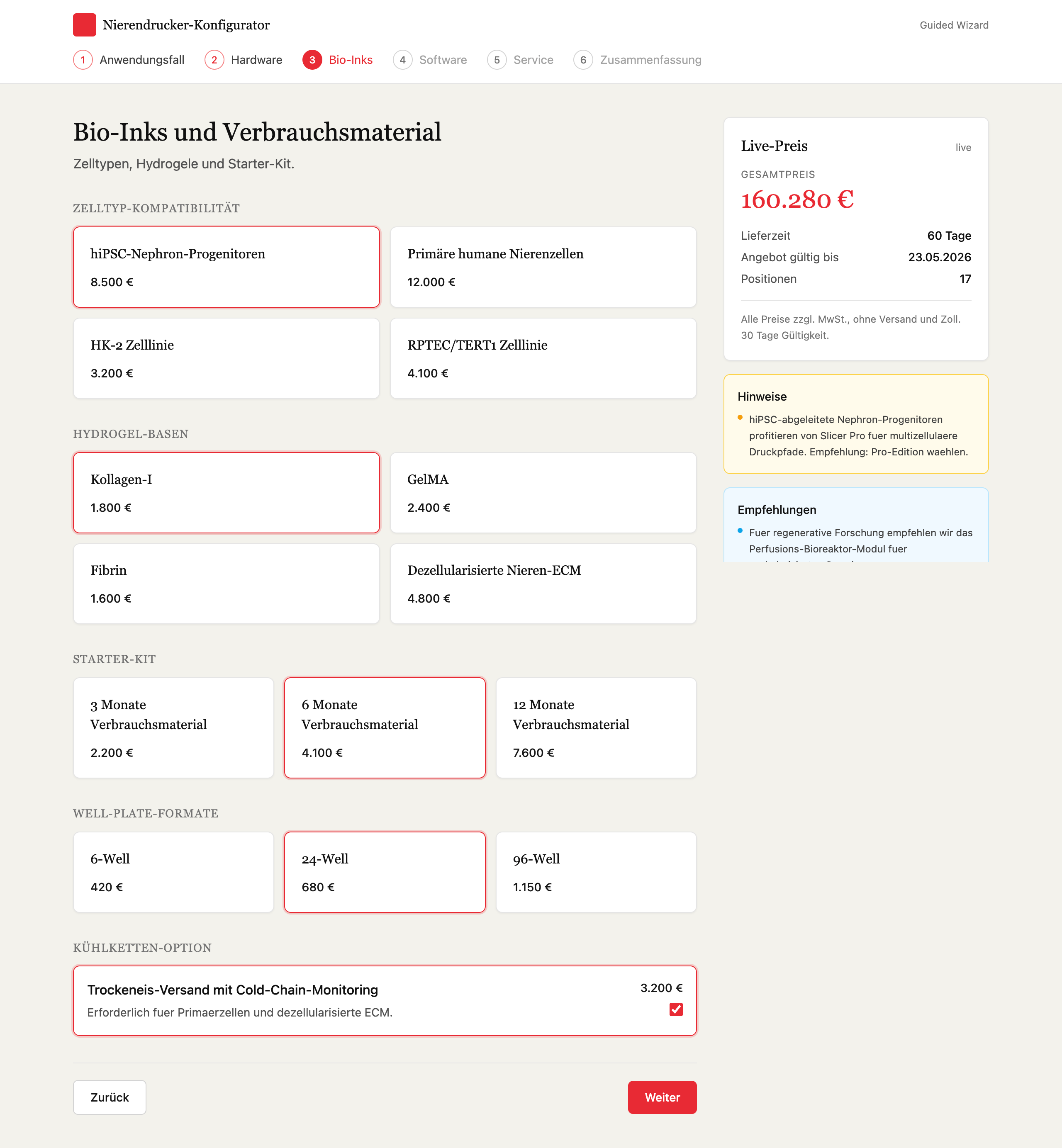 Bio-Inks-Schritt: Zelltyp-Kompatibilität, Hydrogel-Basen, Starter-Kits. Die Empfehlungslogik filtert kompatible Zelllinien anhand des Use-Cases vor.
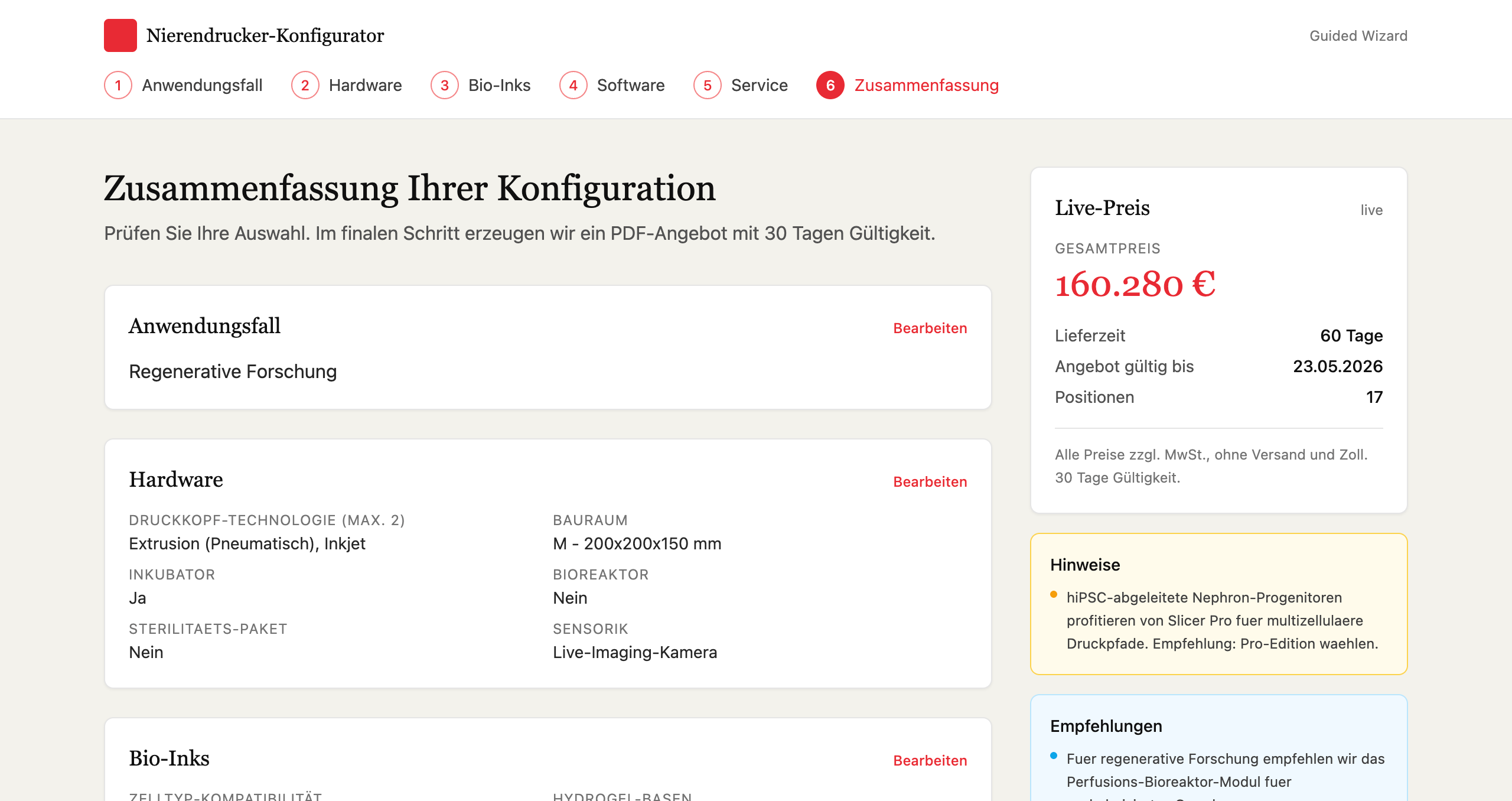 Zusammenfassung: Das Buying Committee bekommt ein gemeinsames Artefakt mit allen vier Konfigurationsdimensionen, dem verbindlichen Preis und 30 Tagen Angebotsgültigkeit.
Was im Dokument steht, war für viele im Raum überraschend, weil es genau die Bestandteile hatte, die ein erfahrener Product Owner liefern würde:
- Drei Personas mit konkreten Use-Cases (Principal Scientist, Einkauf Lifesciences, Qualitätsmanager).
- Vier Konfigurationsdimensionen: Hardware-Module, Bio-Inks, Software/Datenmanagement, Service.
- Architektur-Entscheidung mit Begründung pro Schicht (Next.js App Router, React-Three-Fiber für die 3D-Visualisierung, Neon Postgres für Audit-Log, Vercel Functions in der EU-Region).
- Compliance-Layer mit den Themen, die Bio-Pharma-Käufer wirklich interessieren: EU MDR 2017/745, FDA 510(k), ISO 13485, GAMP 5, 21 CFR Part 11, Export-Control.
- Risiko-Matrix mit Mitigation - inklusive der ehrlichen Aussage, dass "MVP in 6-8 Wochen + alle 4 Konfigurationsdimensionen + CRM/ERP/CPQ-Integration + 3D-Visualisierung + 2 Sprachen + MDR/FDA/ISO-Compliance" in dieser Kombination nicht realistisch ist, und dem Vorschlag eines zweistufigen MVP.
- Acht-Wochen-Timeline vom Discovery & Alignment bis zum Soft-Launch mit Beta-Kunden.
Das ist kein Toy Example. Das ist das, was im Bio-Pharma-Mittelstand aktuell als Lastenheft durchgeht.
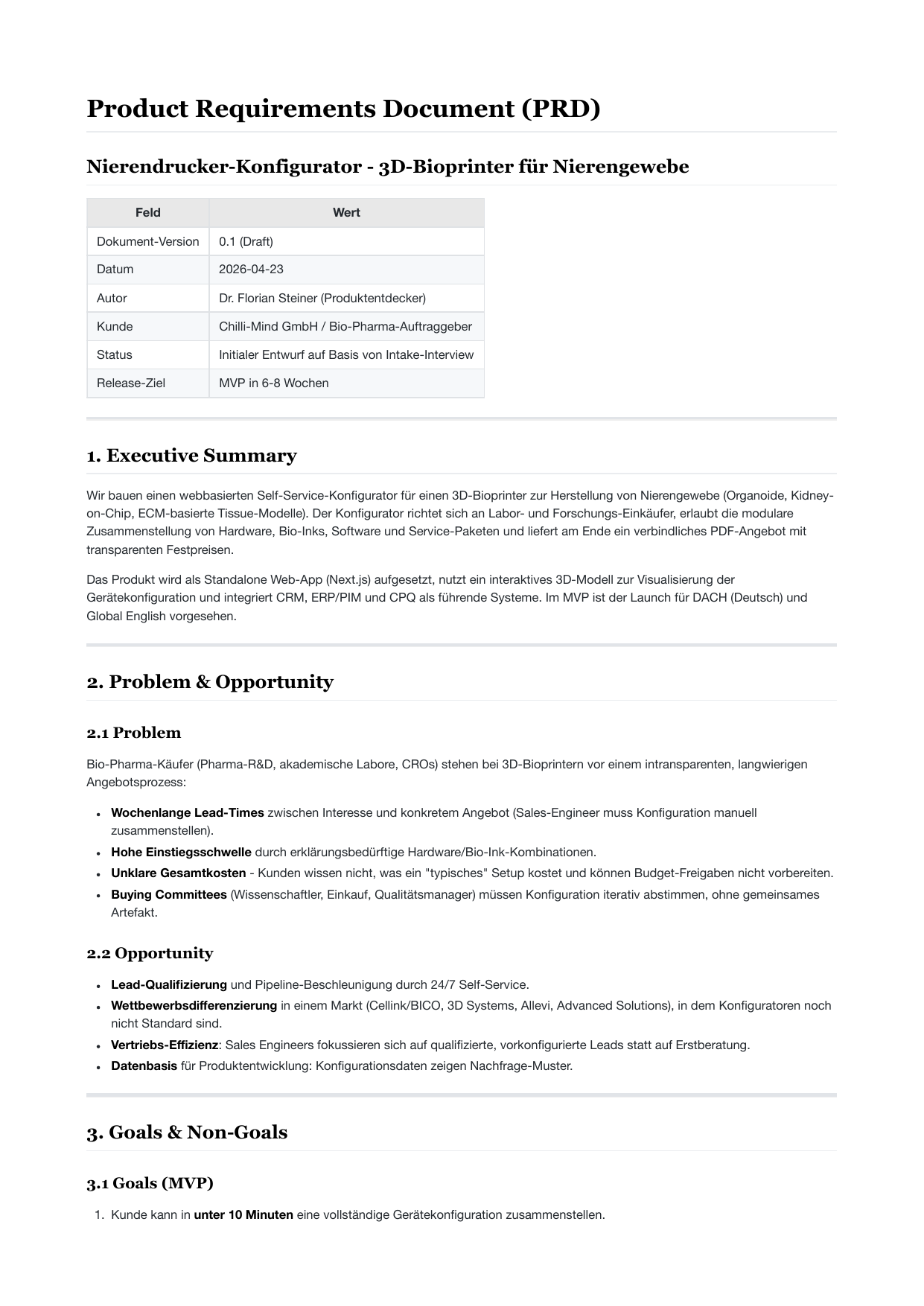
Das vollständige PRD, so wie es aus Claude Code herausgefallen ist. Download als 8-seitiges PDF.
Was die Führungskräfte mitgenommen haben
Drei Beobachtungen, die ich nach dem Seminar noch im Zug nach München aufgeschrieben habe:
Die Hürde liegt nicht in der Technologie, sondern in der Auftragsklärung. Claude liefert genau die Tiefe, die man hineingibt. Wer "mach mir ein PRD" eintippt, bekommt Mittelmaß. Wer das Intake-Interview ernst nimmt und auf Rückfragen sauber antwortet, bekommt ein Dokument, das durch die Wirtschaftsprüfer-Prüfung kommt.
Buying Committees lieben gemeinsame Artefakte. Im Case sind Wissenschaftler, Einkauf und Qualitätsmanager zusammen einkaufsentscheidend. Genau diese Drei-Personen-Konstellation wollte der Konfigurator bedienen. Dass Claude diese Multi-Stakeholder-Dynamik aus einer halben Seite Case Study herausliest und in Personas plus User Stories übersetzt, war für viele im Raum der Aha-Moment.
Die Frage ist nicht "ob", sondern "wie schnell". Wir hatten eine Folie mit drei Punkten: Kosten pro AI-Output fallen pro Jahr um den Faktor zehn, Anthropic Enterprise wächst schneller als OpenAI im B2B, und Nvidia-CEO-Briefings genauso wie sieben-stellige Beratungs-Boutiquen arbeiten täglich mit Claude Code. Die Diskussion danach drehte sich nicht mehr um "Funktioniert das?", sondern um "Wann fangen wir an, und wer im Haus zieht das?"
Was das für CIOs bedeutet
Ich sehe das Muster bei jedem Workshop: IT-Führungskräfte spüren, dass etwas Fundamentales kippt, finden aber intern keine Sprache dafür. Die Mitarbeitenden experimentieren mit ChatGPT, die Kommunikationsabteilung produziert Posts, die Entwicklung schreibt Skripte. Aber niemand weiß, wie das skalierbar wird.
Der Schritt von "Chat-Tool" zu "AI-Kollege mit Projektzugang" ist organisatorisch, nicht technisch. Dafür braucht es:
- Eine CLAUDE.md für jedes Projekt - eine kleine Verfassung, die dem AI-Kollegen Kontext gibt.
- Skills - wiederverwendbare Anleitungen für wiederkehrende Aufgaben (Rechnungsprüfung, Vertragsanalyse, Markt-Research).
- Klare Trennung zwischen "darf das Modell sehen" und "darf das Modell anfassen" - DSGVO-konform und auditierbar.
- Human in the Loop als verbindliche Spielregel, nicht als Lippenbekenntnis.
Genau das ist das Programm, das ich mit Teams in zwei Wochen aufsetze. Nicht ein Workshop, der zeigt was möglich ist - sondern eine Einführung, nach der das Team eigenständig weiterarbeitet.
Materialien und Outcome
Wer ein vergleichbares Setup für die eigene Organisation bauen will - vom Intake-Interview über das PRD bis zum lauffähigen Prototyp - findet hier die nächsten Schritte:
- Claude Code Enablement Sprint - zwei Wochen, in denen ein Team Claude Code wirklich integriert
- AI-Workshop für Führungskräfte - ein bis zwei Tage hands-on, wie an der HSG, mit eurem eigenen Case
- Direkt sprechen - 30 Minuten Klärungsgespräch, ob das passt
Danke an Oliver Gerstheimer und das chilli mind Team für die Co-Moderation und an Bettina von der HSG für die methodische Rahmung. Es war einer dieser Nachmittage, an dem im Raum spürbar war, dass sich das Selbstverständnis einer Profession gerade verschiebt.