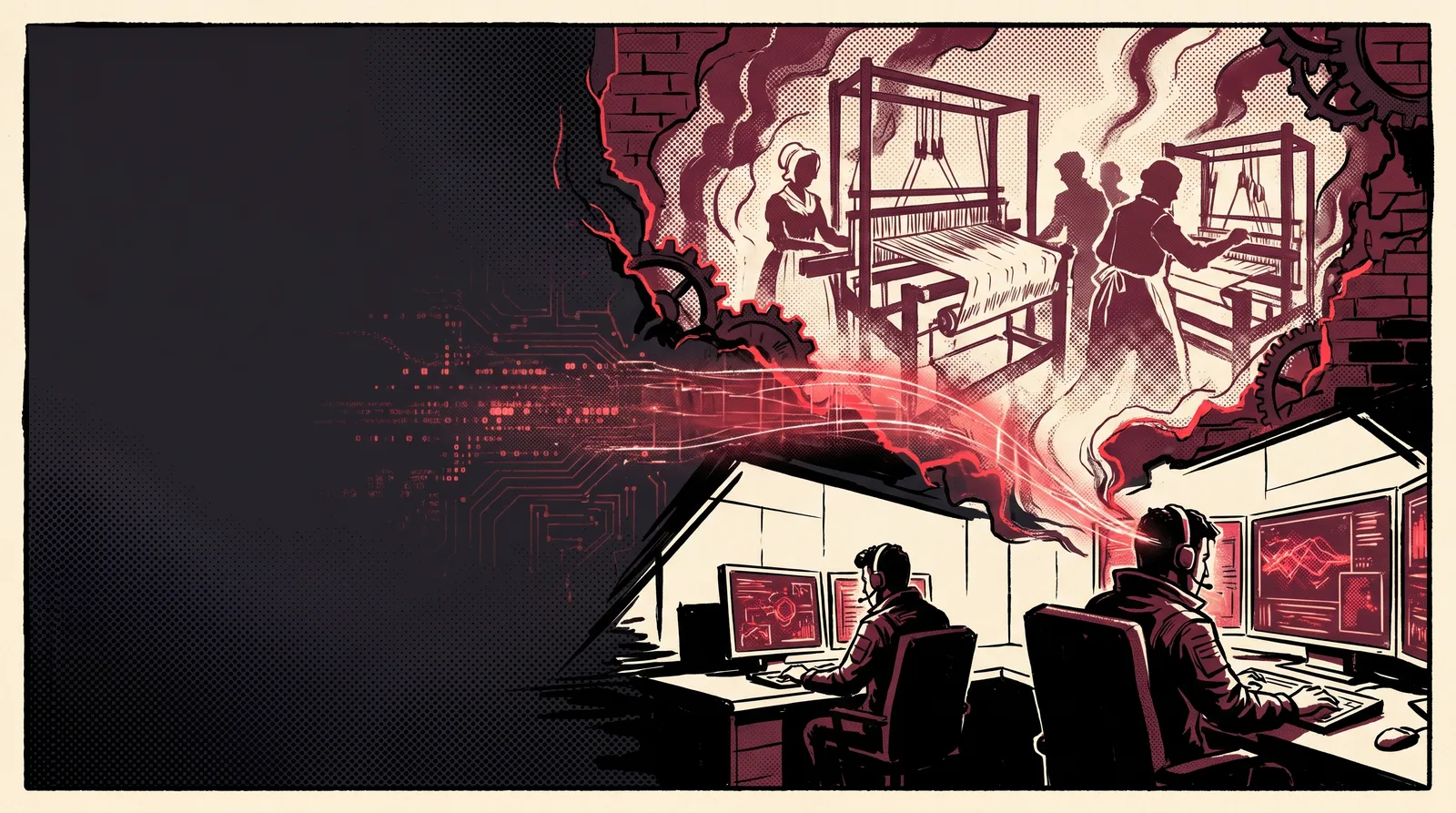
Nachfrageexternalitäten, institutionelle Entscheidungen und die KI-Entlassungsfalle.
Was die Lehrbücher auslassen
Die Geschichte des Kapitalismus wird von seinen Siegern geschrieben, weshalb die Industrielle Revolution in den meisten Lehrbüchern als Erfolgsgeschichte erscheint. Dampf, Stahl und das Fließband hoben einen Großteil der Menschheit aus der Subsistenzlandwirtschaft in ein Zeitalter des Massenwohlstands. Was die Lehrbücher meist auslassen, ist, was mit denen dazwischen geschah — mit jenen, die die Transformation durchlebten, statt später in Büchern davon zu lesen.
Auf ihrem Höhepunkt Mitte der 1820er Jahre beschäftigte die britische Handwebindustrie rund vierhunderttausend Arbeiter im Vereinigten Königreich. Bis 1860 war diese Zahl auf einen Bruchteil ihrer früheren Größe zusammengebrochen. Der Großteil eines Berufsstands — und mit ihm eine Lebensweise, eine Haushaltsökonomie und ein lokales soziales Gefüge — wurde innerhalb eines einzigen Lebens ausgelöscht. Zu Beginn des neunzehnten Jahrhunderts bestritt etwa ein Drittel der britischen Arbeitskräfte seinen Lebensunterhalt noch aus der Landwirtschaft; bis zum frühen zwanzigsten Jahrhundert war dieser Anteil unter zehn Prozent gefallen. Die große Wanderung vom Feld in die Fabrik war keine sanfte Optimierung. Sie war ein Bruch, und ihre Kosten trugen überwältigend jene, die am wenigsten in der Lage waren, sie abzufedern.
Was wir heute als natürlichen Bogen des Fortschritts erinnern, war damals eine zivilisatorische Notlage. Die Reaktion war nicht automatisch. Es brauchte rund ein Jahrhundert an Streiks, Aufständen, parlamentarischen Untersuchungen, Revolutionen und ideologischen Umwälzungen — Chartismus, Sozialismus, Bismarcks Sozialversicherung, den französischen Front Populaire, den New Deal — bevor sich die neue industrielle Ordnung zu etwas stabilisierte, was ein moderner Arbeiter als menschenwürdig erkennen würde. Der Acht-Stunden-Tag und die Fünf-Tage-Woche, oft als natürliche Selbstverständlichkeiten vorgestellt, waren in Wahrheit soziale Erfindungen. Henry Ford, der im Januar 1914 den Fünf-Dollar-Tag mit acht Stunden in seinem Werk in Highland Park ankündigte und 1926 die Fünf-Tage-Woche einführte, tat dies nicht aus Großzügigkeit. Er tat es, weil er etwas verstanden hatte, was die klassischen Ökonomen übersehen hatten: dass die Männer, die das Model T bauten, es sich auch leisten können mussten, eines zu fahren. Ohne Freizeit gibt es keinen Konsum. Ohne Konsum keinen Massenmarkt. Ohne Massenmarkt werden die Effizienzgewinne des Fließbands zum Fluch statt zum Segen.
Dies ist die Lektion, die gegenwärtige Diskussionen über künstliche Intelligenz immer wieder neu entdecken, meist zu spät. Wir erleben eine technologische Transformation, die künftige Lehrbücher mit ziemlicher Sicherheit mit Dampfmaschine und Dynamo vergleichen werden. Wie damals droht das Narrativ direkt vom Problem zur Lösung zu springen, ohne bei den Jahrzehnten der Verwerfung dazwischen zu verweilen. Die Frage ist, ob wir es diesmal besser machen können — nicht weil wir klüger oder gütiger wären, sondern weil wir die Geschichte lesen können, die unsere Vorfahren gerade schrieben.
Was Wirtschaftshistoriker wissen
Es ist ein eigentümliches Merkmal der Ökonomie als Disziplin, dass ihre tiefsten empirischen Einsichten nicht von den Theoretikern stammen, sondern von den Historikern unter ihnen. Ronald Coases Transaktionskostentheorie, die später zur Neuen Institutionenökonomie von Oliver Williamson und Elinor Ostrom reifte, gründete auf sorgfältiger Archivarbeit darüber, wie Firmen im industrialisierenden Großbritannien tatsächlich entstanden. Ostrom, die sich 2009 den Nobelpreis mit Williamson teilte, baute ihren gesamten Rahmen zur Verwaltung von Allmenden auf jahrzehntelanger Feldforschung in Schweizer Alpendörfern, japanischen Fischereien und spanischen Bewässerungsgemeinschaften auf. Und 2024 wurde der Wirtschaftsnobelpreis Daron Acemoglu, Simon Johnson und James Robinson für ein Werk verliehen, das im Kern ein historisches Argument ist: dass der langfristige Wohlstand von Nationen nicht durch Geografie oder Kultur bestimmt wird, sondern durch Institutionen, und dass Institutionen durch politische Entscheidungen unter Druck entstehen und vergehen.
Dies ist die intellektuelle Tradition, in die jede ernsthafte Diskussion über KI gehört. Die Frage ist nicht, ob künstliche Intelligenz die Wirtschaft transformieren wird — sie wird es, und die Transformation ist bereits im Gange — sondern unter welcher institutionellen Konfiguration die Transformation geschieht. Die Industrielle Revolution brachte sowohl die Fabrik als auch die Gewerkschaft hervor, sowohl die Eisenbahn als auch das Kartellrecht, sowohl die chemische Industrie als auch den Clean Air Act. Das Ergebnis war nicht technologisch determiniert. Es war politisch konstruiert, meist im Nachgang von Krisen, die institutionelle Voraussicht hätte verhindern können.
Die romantische Lesart dieser Epoche — eine heldenhafte Ingenieursleistung, die letztlich allen Nutzen brachte — stimmt nur, wenn man über ein Jahrhundert und mehrere Generationen hinweg mittelt. Innerhalb jeder einzelnen Dekade des neunzehnten Jahrhunderts war die Verteilungsgeschichte brutal. Löhne für ungelernte Arbeit in Manchester, Leeds, Lille, Mülhausen und dem Ruhrgebiet stagnierten oder fielen in der ersten Hälfte der 1800er-Jahre, obwohl der industrielle Output sich vervielfachte. Die Lebenserwartung in den Industriestädten sank. Kinderarbeit breitete sich aus. Qualifizierte Handwerker — die fähigsten und produktivsten Arbeiter ihrer Zeit — wurden systematisch verarmt, während ihr handwerkliches Wissen zuerst in Maschinen und dann in Prozesshandbücher eingebettet wurde, geschrieben von Männern, die nie einen Webstuhl berührt hatten. Die Geschichte, dass die Industrielle Revolution gut für die Menschheit war, ist retrospektiv. Die Geschichte, dass sie für die meisten Menschen, die sie durchlebten, grauenvoll war, ist zeitgenössisch. Beide sind wahr. Wirtschaftshistoriker wissen das. Makroökonomische Modelle, die auf Nachkriegszeitreihen trainiert sind, neigen dazu, es zu vergessen.
Die Falle
Eine aktuelle theoretische Arbeit von Brett Hemenway Falk von der University of Pennsylvania und Gerry Tsoukalas von der Boston University, The AI Layoff Trap, schärft das gegenwärtige Problem in seiner reinsten analytischen Form. Anhand eines kompetitiven, aufgabenbasierten Modells des Firmenverhaltens zeigen die Autoren, dass rationale, gewinnmaximierende Firmen einer dominanten Strategie folgen, menschliche Arbeit durch Automatisierung zu ersetzen — selbst wenn jede Firma in der Ökonomie versteht, dass genau dies die Konsumnachfrage erodiert, von der ihre eigenen Erlöse abhängen.
Der Mechanismus ist eine Nachfrageexternalität. Wenn eine einzelne Firma einen Arbeiter durch KI ersetzt, kassiert sie den vollen Produktivitätsgewinn, während sie den Einkommensverlust — und damit den Nachfrageverlust — über die gesamte Ökonomie verteilt. Aus Sicht der Firma ist Automatisierung privat profitabel, selbst wenn sie kollektiv katastrophal ist. Die Logik entspricht der klassischen Tragödie der Allmende: Jeder Akteur, der lokal optimiert, hilft mit, genau jene Ressource zu zerstören, von der alle abhängen. Hier ist die Allmende die aggregierte Nachfrage, und die erschöpfte Ressource ist die Kaufkraft der arbeitenden Bevölkerung.
Was das Falk–Tsoukalas-Ergebnis besonders unbequem macht, ist die Liste der Lösungen, die es ausschließt. Mehr Marktwettbewerb, den Ökonomen typischerweise gegen Ineffizienz verschreiben, verstärkt den Exzess sogar: Wenn Firmen härter um Kosten konkurrieren, automatisieren sie schneller, und der Druck auf die Nachfrage steigt. Freier Marktzugang löst das Problem nicht, weil neue Anbieter denselben individuellen Anreizen unterliegen wie die etablierten. Lohnanpassungen können das Gleichgewicht nicht wiederherstellen, sobald das Grenzprodukt der Arbeit unter das Existenzminimum gefallen ist; der Markt räumt dann einfach bei null Stunden. Kapitaleinkommensteuern, die Renten nachträglich umverteilen, ändern das Verhalten nicht, das die Verzerrung überhaupt erst erzeugt hat — sie verteilen lediglich einen schrumpfenden Kuchen um. Auch die Beteiligung der Arbeitnehmer am Eigenkapital, ein Liebling progressiver Kommentatoren, funktioniert nicht: Den Arbeitnehmern Anteile an der Firma zu geben, die sie automatisiert, ändert die dominante Strategie der Firma nicht. Bedingungsloses Grundeinkommen lindert das Symptom, lässt aber die zugrunde liegende Wettbewerbsdynamik unberührt — und macht es für Firmen sogar billiger, Arbeiter zu entlassen, weil die politischen Kosten von Entlassungen sinken. Weiterbildung — der ewige Trostpreis für Entlassene — setzt voraus, dass die Menge der menschlichen Exklusiv-Aufgaben nicht selbst schrumpft, und genau das ist die Annahme, die in einer KI-Transition auf dem Spiel steht.
Die Coase-Verhandlung, der Standardeinwurf der Eigentumsrechtsökonomie, bricht aus Gründen zusammen, die Oliver Williamson in seiner Verfeinerung von Coase kanonisch formuliert hat. Es reicht nicht, zu sagen, die Externalität sei zu diffus; die tieferen Reibungen sind drei. Begrenzte Rationalität verhindert, dass Firmen die relevanten Externalitäten über einen sich kontinuierlich ändernden Aufgabenraum überhaupt aufzählen können. Opportunismus sorgt dafür, dass jene, die vom Abweichen von einem freiwilligen Automatisierungspakt profitieren würden, jeden Anreiz haben, es zu tun. Und die Faktorspezifität der beteiligten Aufgaben ist asymmetrisch auf eine Weise, die private Verhandlungen zum Scheitern verurteilt: Die verdrängten Arbeiter sind oft firmenspezifisch, aber der Nachfrageverlust, den ihre Verdrängung erzeugt, verteilt sich über die gesamte konsumierende Ökonomie, und es gibt keinen Akteur, der im Namen der Letzteren verhandeln könnte.
Was im Falk–Tsoukalas-Modell bleibt, ist ein einziges Instrument: eine Pigou-Steuer auf die Automatisierung selbst, so bemessen, dass sie die Nachfrageexternalität internalisiert und die firmenindividuellen Anreize mit dem kollektiven Wohlergehen in Einklang bringt. Man muss nicht jeder Modellentscheidung zustimmen, um den strukturellen Punkt ernst zu nehmen. Falk und Tsoukalas sind nicht die ersten, die eine Automatisierungssteuer vorschlagen — Bill Gates brachte die Idee 2017 öffentlich ins Spiel, und Daron Acemoglu hat seit Jahren Varianten davon skizziert — aber sie gehören zu den ersten, die innerhalb einer handhabbaren Mikrofundierung zeigen, dass die meisten Alternativen im aktuellen Politmenü das Problem, das sie lösen sollen, gar nicht beheben. Sie adressieren die Folgen, nicht die Ursache.
Es gibt jedoch eine weitere Komplikation, die die Annahme symmetrischer Firmen im Modell dezent verbirgt. KI ist keine monolithische Technologie, sondern ein Stack — Foundation Models, Inferenz-Infrastruktur, Deployment-Tooling, vertikale Anwendungen, proprietäre Daten, Vertriebsnetze. David Teece argumentierte in seinem Aufsatz Profiting from Technological Innovation (1986), dass in schwachen Aneignungsregimen der Innovator den Wert selten einbehält; die Eigentümer komplementärer Vermögenswerte tun es. Auf den heutigen Stack angewandt lautet die Frage: Wer kassiert die Automatisierungsrenten eigentlich? Wenn Foundation-Model-Anbieter als Engpassmonopole agieren, während Deployer den Überschuss wegkonkurrieren, verschärft sich die Nachfrageerosion, weil sowohl die verdrängten Arbeiter als auch die operierenden Firmen verlieren und eine konzentrierte Upstream-Schicht wenig von dem konsumiert, was sie extrahiert. Sind umgekehrt Deployment-Know-how und proprietäre Daten die bindenden komplementären Assets, ist die Rentenverteilung flacher und das dystopische Szenario milder. Dieser Essay wird nicht vorgeben, die Frage empirisch zu klären. Sie wird hier notiert, weil jede politische Antwort sich damit auseinandersetzen muss: Eine Pigou-Steuer, die an der falschen Marge erhoben wird oder ohne Kenntnis davon, wo die Renten tatsächlich anfallen, wird die Externalität, die sie internalisieren soll, nicht erfassen.
Arbeit ist nicht nur Einkommen
Es gibt ein Register, in dem die Rahmung von Falk und Tsoukalas bereits zu eng ist. Die Arbeit beschreibt die Kosten der Verdrängung als verlorene Gesamtnachfrage — eine präzise Beschreibung des makroökonomischen Mechanismus, aber eine unvollständige Beschreibung des menschlichen Einsatzes. Arbeit ist, in jeder Gesellschaft, die sich je um sie organisiert hat, mehr als eine Einkommensquelle. Sie ist ein Ort biografischer Integration und intersubjektiver Anerkennung: der Kontext, in dem gewöhnliche Menschen sich als kompetente Mitglieder einer Gemeinschaft verstehen lernen, Rollen annehmen, die andere anerkennen, und sich in einer Erzählung des Beitragens verorten. Jürgen Habermas' Unterscheidung zwischen System und Lebenswelt bringt den Punkt präzise auf den Begriff. Die hier verhandelte Verdrängung wirkt auf beiden Registern zugleich. Wenn Arbeitern gesagt wird, dass ihre Aufgaben von einer Maschine erledigt werden können, kollabiert nicht nur ihre Kaufkraft, sondern auch die soziale Architektur, durch die sie verstehen, wer sie sind.
Die Unterscheidung ist politisch wie analytisch bedeutsam, denn sie öffnet den Blick auf einen Versagensmodus, den ein rein ökonomisches Modell nicht sehen kann. Wenn Arbeit nur eine Einkommensquelle ist, kann ihr Verlust im Prinzip mit einer Transferzahlung kompensiert werden — etwa einem bedingungslosen Grundeinkommen. Wenn Arbeit auch ein Ort der Identitätsbildung und sozialen Integration ist, lösen Transferzahlungen nur die Hälfte des Problems, und eine Bevölkerung, die den Scheck erhält, aber die Rolle verliert, ist dadurch nicht mit der neuen Ordnung versöhnt. Das ist das Terrain, das Habermas in Legitimationsprobleme im Spätkapitalismus (1973) kartiert hat: Wenn ein ökonomisches System die Massenbeschäftigung nicht mehr liefern kann, von der seine politische Legitimität stillschweigend abhängt, öffnet sich ein Legitimationsdefizit, das sich nicht von selbst schließt. Die empirische Signatur eines solchen Defizits ist vertraut — erodierende Wahlbeteiligung, institutionelles Misstrauen, der Aufstieg von Bewegungen, die Identität dort anbieten, wo die Ökonomie keine Rollen mehr bietet — und sein Bezug zur kommenden KI-Transition ist direkt.
Drei Zukünfte
Den Raum möglicher Ergebnisse lässt sich entlang zweier Dimensionen skizzieren: ob Firmen KI primär einsetzen, um Kapital für Arbeit zu substituieren, oder um den Horizont dessen zu erweitern, was Arbeit leisten kann; und ob Institutionen früh genug reagieren, um das Wettbewerbsgleichgewicht zu gestalten, oder erst, nachdem der Schaden entstanden ist. Vier Kombinationen sind logisch möglich, aber nur drei sind analytisch interessant.
Die erste ist das dystopische Szenario, vor dem Keynes 1930 unter einem anderen Namen warnte. Wenn Firmen aggressiv automatisieren, während Institutionen hinterherhinken, gleitet die Ökonomie in eine deflationäre Spirale mit negativer Rückkopplung. Arbeiter verlieren Beschäftigung und Einkommen. Haushalte, unsicher über ihre Zukunft, erhöhen ihre Vorsorgeersparnis und reduzieren den Konsum. Die aggregierte Nachfrage schrumpft. Firmen sehen ihre Umsätze fallen und reagieren mit weiteren Kostensenkungen — meist durch mehr Automatisierung, weil Arbeit die einfachste Position zum Streichen ist. Preise driften nach unten, reale Schuldenlasten steigen, Investitionen stagnieren, und die Ökonomie gleitet in das, was Irving Fisher 1933 Schuldendeflation nannte und was Japan seit 1991 in Zeitlupe erlebt. Das Sparparadoxon — dass Verhalten, das für den einzelnen Haushalt rational ist, zerstörerisch wird, wenn alle Haushalte es gleichzeitig praktizieren — erscheint in einem neuen Register als Automatisierungsparadoxon. Jeder Teilnehmer spielt das Spiel korrekt. Das Spiel selbst ist fehlgeleitet.
Die zweite Trajektorie wird in der ökonomischen Debatte seltener diskutiert, ist historisch aber häufiger. Sie ist der Legitimationspfad, auf dem die makroökonomischen Aggregate nicht zwingend kollabieren, das politische und soziale Gefüge aber schon. Ein hinreichender Teil der Bevölkerung wird sichtbar und rasch genug verdrängt, dass die Verlierer der Ordnung, die sie verdrängt, die Zustimmung entziehen. Die Wahlbeteiligung erodiert unter den Unzufriedenen. Anti-System-Bewegungen fangen ihre Aufmerksamkeit ein und bieten Identität und Sinn, wo die Ökonomie keine Rollen mehr anbietet. Das institutionelle Vertrauen fällt unter das Niveau, das für jene politischen Antworten nötig wäre, die die Transition sonst abfedern könnten. Die historischen Signaturen sind vertraut: die 1930er Jahre auf einem Register, das Wiedererstarken autoritärer und nativistischer Politik in Europa und Nordamerika der 2010er Jahre auf einem anderen. Dieser Pfad braucht keine deflationäre Spirale. Er braucht nur, dass der Arbeitsverlust konzentriert, sichtbar und institutionell unbehandelt bleibt. Er kann eintreten, selbst wenn das BIP akzeptabel aussieht — gerade weil Eliten die Aggregate lesen und die Verteilung übersehen.
Die beiden Trajektorien schließen sich nicht gegenseitig aus; ein moderater ökonomischer Schock kann durchaus eine scharfe politische Reaktion erzeugen, wenn er als konzentriert und ungerecht empfunden wird.
Die dritte Trajektorie hängt von einer anderen Reihe von Entscheidungen ab. Wenn Firmen KI primär einsetzen, um den Umfang und die Qualität dessen zu erweitern, was Arbeiter tun können, statt sie zu ersetzen, wird der Produktivitätsgewinn geteilt, die Nachfrage bleibt erhalten, und eine positive Rückkopplung entsteht: bessere Produkte, schnellerer Markteintritt, steigende Löhne, wachsender Konsum und weitere Innovation. Acemoglu und Pascual Restrepo haben dies den Wiedereinsatz-Effekt genannt — die Art, wie technologischer Wandel historisch neue Aufgaben schafft, während er alte zerstört — und sie haben betont, dass Wiedereinsatz nicht automatisch eintritt. Er geschah im zwanzigsten Jahrhundert, weil Institutionen, Gewerkschaften und öffentliche Investitionen die Anreize in Richtung arbeitsergänzender statt arbeitsersetzender Technologien ausrichteten. Die Computerrevolution der 1980er und 1990er brachte bei aller Disruption ebenso viele neue Berufe hervor, wie sie vernichtete, auch weil komplementäre Investitionen in Bildung und öffentliche Infrastruktur die Erträge der Arbeit neben denen des Kapitals steigen ließen. Im einundzwanzigsten Jahrhundert kann das scheitern, wenn diese institutionellen Abstimmungen fehlen oder abgebaut werden.
Welchem dieser drei Pfade gefolgt wird, ist keine Frage der Prognose, sondern der Entscheidung. Und die Entscheidung fällt jetzt, in Firmen, Ministerien und Parlamenten, die größtenteils nicht bemerken, dass sie sie treffen.
Polanyis Doppelbewegung
Karl Polanyi, der 1944 am Ende des zerstörerischsten Jahrzehnts der Menschheitsgeschichte schrieb, bot einen Rahmen, um zu verstehen, warum Marktgesellschaften sich periodisch krampfen. Sein zentraler Begriff war die fiktive Ware: Arbeit, Boden und Geld werden vom Markt behandelt, als wären sie zum Verkauf produziert worden, sind es aber nicht. Arbeit im Besonderen ist untrennbar von den Menschen, die sie verrichten, und eine Gesellschaftsordnung, die dies ignoriert, bringt sich auf einen Kollisionskurs mit den Leben, die sie organisiert. Jede Ausweitung ungebremster Marktlogik, so Polanyi, provoziert schließlich eine politische Gegenbewegung, die die Gesellschaft vor den Konsequenzen des Marktes schützen will. Die Gegenbewegungen waren manchmal konstruktiv — Bismarcks Sozialversicherungsgesetze, das britische Arbeitsrecht, das Regulierungsgebäude des amerikanischen New Deal, die europäische soziale Marktwirtschaft der Nachkriegszeit — und manchmal katastrophal — Faschismus, Autarkie, revolutionäre Gewalt, ethnischer Nationalismus. Welche Form die Gegenbewegung annimmt, hängt in erheblichem Maße davon ab, welche institutionellen Optionen verfügbar sind, wenn der Druck unerträglich wird. Eine Gesellschaft, die die Stoßdämpfer vorgebaut hat, bringt tendenziell Bismarck und Roosevelt hervor. Eine Gesellschaft, die dies nicht getan hat, bringt tendenziell etwas Schlimmeres hervor.
Es lohnt sich, daran zu erinnern, wie die unbewältigten Varianten tatsächlich aussahen. Die Ludditen von 1811 bis 1816 — nicht die leichtgläubigen Maschinenstürmer der romantischen Imagination, sondern die qualifizierten Nottinghamshire-Weber und Yorkshire-Scherer, deren gesamtes Handwerk durch den mechanischen Webstuhl ausgelöscht wurde — zerschlugen Maschinen nicht aus Dummheit. Sie zerschlugen sie, weil das Parlament die Arbeitsschutzrechte, die den technologischen Wandel zuvor gedämpft hatten, aufgehoben hatte, und weil die Napoleonischen Kriege die Lebensmittelpreise auf Hungerniveau getrieben hatten, während die Mühlenbesitzer den Überschuss einstrichen. Sie irrten sich nicht darüber, was ihnen geschah, sondern nur darüber, was es aufhalten konnte. Eine Generation später brachte das Manchester-Modell des Industriekapitalismus die Bedingungen hervor, die Friedrich Engels in Die Lage der arbeitenden Klasse in England (1845) katalogisierte — Zwölf-Stunden-Tage, Kinderarbeit, unhygienische Wohnverhältnisse, routinemäßige Arbeitsunfälle — und diese Bedingungen erzeugten innerhalb von drei Jahren das Kommunistische Manifest. Innerhalb von siebzig Jahren hatten sie die Russische Revolution, die Chinesische Revolution und einen globalen ideologischen Wettstreit organisiert, der die internationale Politik für den größten Teil des zwanzigsten Jahrhunderts ordnete. Die Frage, die die Kommunisten stellten — was mit einer Gesellschaft geschieht, die Menschen als minimierbaren Produktionsfaktor behandelt — war nicht die falsche Frage. Die Antwort, die sie vorschlugen, war an den meisten Orten, an denen sie versucht wurde, schlimmer als das Problem. Aber das Problem war real, und wo es unbehandelt blieb, erzeugte es noch schlimmere Antworten.
Dies ist der analytische Rahmen, in den die KI-Transition zu stellen ist. Es reicht nicht, die Technologie zu beschreiben, auch nicht den ökonomischen Mechanismus, durch den die Technologie Arbeitslosigkeit erzeugt. Man muss zusätzlich fragen, welche Art Gegenbewegung gerade vorbereitet wird. Die institutionelle Architektur des Sozialstaats des mittleren zwanzigsten Jahrhunderts wurde nicht in den 1930ern gebaut. Sie wurde in den Jahrzehnten davor gebaut — in der Progressive Era, den deutschen Sozialreformen der 1880er, den britischen Liberal-Reformen von 1906 bis 1911, dem munizipalen Sozialismus der Jahrhundertwende. Als die Große Depression kam, war der begriffliche Werkzeugkasten bereits verfügbar. Das Gleiche wird für die KI-Transition gelten: Die Instrumente, die in der eventuellen Krise beschlossen werden, werden jene sein, die in den Jahren davor gebaut, theoretisiert und erprobt wurden. Das gegenwärtige Jahrzehnt ist daher keine Zeit zum Abwarten. Es ist die Zeit, in der der Werkzeugkasten der nächsten vierzig Jahre zusammengestellt wird.
Die institutionelle Frage
Wenn das Falk–Tsoukalas-Modell recht hat, dass firmenindividuelle Anreize unter KI auf ein Ergebnis zusteuern, das für Firmen selbst schlecht ist, lautet die praktische Frage, welche institutionelle Konfiguration die Anreize wieder in Einklang bringen kann. Das Menü ist größer, als die gegenwärtige Politikdebatte nahelegt, und Kontinentaleuropa hat bereits mehr davon erprobt, als die angloamerikanische Diskussion üblicherweise anerkennt.
Eine Pigou-Steuer auf Automatisierung ist ein Hebel, und ein ernstzunehmender: Sie wirkt an der Marge, an der die Verzerrung tatsächlich erzeugt wird, statt an den nachgelagerten Folgen. Die administrative Ausgestaltung ist nicht trivial — zu definieren, was als Automatisierung zählt, produktivitätssteigernde von arbeitsverdrängenden KI-Anwendungen zu unterscheiden, Kapitalfluchteffekte in offenen Ökonomien zu vermeiden — aber keines dieser Probleme unterscheidet sich kategorisch von jenen, die bereits der Unternehmens- oder CO₂-Besteuerung anhängen. Ein Jahrzehnt Erfahrung mit dem Design von Kohlenstoffpreisen überträgt sich direkt.
Ein zweiter Hebel ist die Institutionalisierung von Stimme innerhalb der Firma. Die deutsche Mitbestimmung, im Betriebsverfassungsgesetz von 1952 kodifiziert und im Mitbestimmungsgesetz von 1976 substanziell erweitert, verleiht Betriebsräten Informations- und Konsultationsrechte bei erheblichen operativen Änderungen — einschließlich, in der Praxis, der Einführung neuer Technologien, die Arbeitsabläufe, Arbeitsbelastung oder Beschäftigtenzahlen verändern (§§ 90 und 91 BetrVG). In Firmen mit mehr als zweitausend Beschäftigten halten die Arbeitnehmer nahezu paritätische Vertretung im Aufsichtsrat. Williamsons Neue Institutionenökonomie würde dies als hybriden Governance-Modus einordnen, angesiedelt zwischen Marktvertrag und hierarchischem Befehl, und der Punkt ist gerade, dass er endogen wirkt: Er prägt die Automatisierungsentscheidungen der Firma, bevor ein Regulator tätig werden muss. Aus habermasianischer Sicht ist er zudem eine deliberative Institution, die den von Automatisierung Betroffenen einen prozeduralen Anspruch gibt, an der Entscheidung teilzuhaben, statt nur nachträglich kompensiert zu werden. Beide Lesarten legen nahe, dass die gegenwärtige Vernachlässigung der Mitbestimmung in der Debatte ein analytischer Verlust ist.
Ein dritter Hebel ist die Erhaltung der Arbeitgeber–Arbeitnehmer-Beziehung durch strukturelle Übergänge hindurch. Das deutsche Kurzarbeitergeld, mit Wurzeln im Kali-Gesetz von 1910 und in den 1920er Jahren formalisiert, ersetzt einen Teil der entgangenen Löhne der Beschäftigten, wenn Firmen Stunden statt Köpfe reduzieren. Es wurde in der Finanzkrise 2008 (rund 1,4 Millionen Arbeiter) und in der Pandemie 2020 (Höhepunkt bei nahezu 6,7 Millionen im Mai) in beispiellosem Umfang eingesetzt. Die italienische Cassa Integrazione Guadagni, die aus dem Jahr 1941 stammt und nach dem Krieg substanziell erweitert wurde, erfüllt die analoge Funktion und ersetzt fünfzig bis achtzig Prozent des entgangenen Einkommens für Arbeiter, die wegen wirtschaftlicher oder technischer Störungen stillgestellt sind. Beide Institutionen waren für zyklische Schocks konzipiert, aber ihre strukturelle Logik — die Kosten der Transition zwischen Öffentlichkeit und Firma zu verteilen, statt sie auf die verdrängten Arbeiter zu konzentrieren — ist genau die Logik, die eine KI-Transition erfordert. Sie sind im Falk–Tsoukalas-Rahmen partielle Substitute für die Automatisierungssteuer, weil sie die Haushaltsnachfrage und die Arbeitgeber-Arbeitnehmer-Zuordnungen über das Anpassungsfenster hinweg aufrechterhalten.
Ein vierter Hebel ist die Arbeitszeitverkürzung, das Instrument, das Ford 1926 erfand und Europa wiederholt aktualisiert hat. Der französische Front Populaire unter Léon Blum legiferierte im Juni 1936 die Vierzig-Stunden-Woche und zwei Wochen bezahlten Urlaub — Jahrzehnte, bevor der Gedanke auf der anderen Seite des Ärmelkanals normal wurde. Die Maßnahme wurde unter den letzten Regierungen der Dritten Republik teilweise zurückgerollt, eine nützliche Erinnerung daran, dass institutionelle Errungenschaften reversibel sind; aber sie etablierte die Vorlage, und die französische Loi Aubry von 1998–2000, die die gesetzliche Woche auf fünfunddreißig Stunden senkte, war ihre direkte Nachfolgerin. Die gegenwärtigen Vier-Tage-Woche-Experimente in Island, dem Vereinigten Königreich, Portugal und Spanien gehören zur selben Linie. Im Falk–Tsoukalas-Rahmen verteilt das teilweise Weitergeben von Produktivitätsgewinnen als Freizeit statt vollständig als Beschäftigungsreduktion die Dividende so, dass die aggregierte Nachfrage ohne explizites Umverteilungsschema erhalten bleibt.
Ein fünfter Hebel ist der präventive Aufbau von Wohlfahrts- und Qualifizierungsinfrastruktur. Bismarcks gesetzliche Krankenversicherung (1883), Unfallversicherung (1884) sowie Alters- und Invaliditätsversicherung (1889) wurden nicht aus Großzügigkeit beschlossen; sie wurden, wie Bismarck dem Reichstag sagte, beschlossen, um sozialistische Agitation inmitten der industriellen Verwerfungen der 1870er und 1880er zu entschärfen. Sie wirkten: Der konservativste deutsche Kanzler des Jahrhunderts konstruierte den ersten modernen Sozialstaat und baute dabei die Stoßdämpfer vor, die Deutschland durch spätere Transitionen trugen. Das amerikanische Pendant sind der Morrill Act von 1862, der die land-grant universities finanzierte; der GI Bill von 1944, der eine Generation technisch qualifizierter Veteranen unterstützte; und der National Defense Education Act von 1958, der die Nachkriegs-Technologiefront in arbeiterfreundliche Richtungen lenkte. In jedem Fall prägten öffentliche Institutionen die Zusammensetzung der Investitionen auf eine Weise, die privates Kapital sich selbst überlassen nicht gewählt hätte. Die Forschungsprioritäten der National Science Foundation, des European Research Council und ihrer Pendants sind daher keine Nebenschauplätze der KI-Debatte. Sie sind Hebel erster Ordnung.
Ein sechster Hebel, aktuell nur in Europa sichtbar, ist die präventive Regulierung der Technologie selbst. Der EU AI Act, am 1. August 2024 in Kraft getreten und mit dem Gros der Hochrisiko-Pflichten ab August 2026 anwendbar, ist der erste umfassende risikobasierte Rechtsrahmen für KI weltweit. Seine Hochrisiko-Kategorie umfasst ausdrücklich KI-Systeme, die in Beschäftigung und im Management von Arbeitnehmern eingesetzt werden. Was immer man von seinen einzelnen Bestimmungen hält — der Act stellt einen kategorialen Bruch mit dem reaktiven Muster des neunzehnten Jahrhunderts dar: eine institutionelle Vor-Konstruktion, gesetzlich normiert vor, nicht nach der Massenverdrängung. Die deutschen und französischen Industriemodelle wurden überwiegend nach den Disruptionen konstruiert, auf die sie antworteten. Der EU AI Act ist ein Versuch, die Institution vor der Disruption zu bauen. Er wird im Verhältnis zu den anderen fünf Hebeln gelingen oder scheitern.
Keines dieser Instrumente ist für sich genommen ausreichend. Alle sind leichter vor der Krise als in ihr zu beschließen.
Mindestens eine große europäische Volkswirtschaft hat jüngst den umgekehrten Fall illustriert. Die deutschen Hartz-Reformen von 2003 bis 2005 flexibilisierten den Arbeitsmarkt, deregulierten Zeitarbeit und kürzten Langzeitarbeitslosenleistungen; sie senkten zwar die Schlagzeilen-Arbeitslosenquote, erweiterten aber zugleich den Niedriglohnsektor und schwächten genau die Stoßdämpfer, um die das Nachkriegsmodell gebaut worden war. Die Lektion lautet nicht, dass Flexibilität immer falsch sei; sie lautet, dass die institutionelle Architektur tragend ist und dass ihre Demontage in normalen Zeiten die Gesellschaft, die sie demontiert, Risiken aussetzt, die zu beherrschen sie die Fähigkeit verloren hat.
Dies ist die zentrale Einsicht, die ein Wirtschaftshistoriker in den gegenwärtigen Moment einbringen würde: Die institutionellen Entscheidungen, die in normalen Zeiten am radikalsten aussehen, erscheinen im Rückblick wie die Minimalbedingungen zur Vermeidung von Katastrophen. Der Acht-Stunden-Tag wurde 1866 als utopisch verworfen und 1936 als selbstverständlich betrachtet. Der Sozialstaat wurde in den 1880ern als sozialistisches Abenteurertum angeprangert und in den 1950ern als Fundament politischer Stabilität akzeptiert. Allgemeine Gesundheitsversorgung war 1910 ein Randthema und bis 1970 in den meisten industrialisierten Staaten eine etablierte Norm. Die Gegenbewegungen ereigneten sich. Die Frage war immer nur, ob rechtzeitig, und zu welchen Kosten.
Die Entscheidung, die jetzt fällt
Die KI-Transition ist kein Ereignis, das uns widerfährt. Sie ist eine Folge von Entscheidungen, die gerade jetzt getroffen werden, in Firmen, Regierungen, Investmentkomitees und Regulierungsbehörden. Jede dieser Entscheidungen wird von Menschen getroffen, die individuell rational, institutionell eingehegt und weitgehend nicht im Bewusstsein sind, dass sie gemeinsam das erste Kapitel einer Wirtschaftsgeschichte schreiben, die ihre Enkel lesen werden.
Das Falk–Tsoukalas-Papier ist wichtig nicht deshalb, weil seine spezifische Politikempfehlung übernommen wird oder nicht, sondern weil es die Struktur des Problems klärt. Das Problem besteht nicht darin, dass Firmen gierig oder Arbeiter unvorbereitet oder die Technologie zu schnell wäre. Das Problem besteht darin, dass das Wettbewerbsgleichgewicht unter den aktuellen Institutionen auf ein Ergebnis zusteuert, das sowohl Firmenbesitzern als auch Arbeitern schadet. Der Ausweg führt nicht über individuelle Tugend oder bessere Weiterbildungsprogramme. Der Ausweg führt über die bewusste Konstruktion von Institutionen, die die Auszahlungen ändern, mit denen Firmen konfrontiert sind, wenn sie die Marginalentscheidung treffen, eine weitere Aufgabe zu automatisieren — und über die bewusste Konstruktion von Verfahren, deliberativ und demokratisch, durch die die am stärksten Betroffenen einen berechtigten Anspruch haben, an der Entscheidung teilzunehmen.
Das haben erfolgreiche Volkswirtschaften während der Industriellen Revolution schließlich getan, zu furchtbaren Kosten. Die Frage des gegenwärtigen Moments lautet, ob diese Kosten erneut in voller Höhe gezahlt werden müssen — oder ob eine Generation, die die Geschichte lesen kann, sich ausnahmsweise dafür entscheidet, ihr gemäß zu handeln.
Die Entscheidung ist nicht die der Maschine. Sie ist unsere — wenn wir auf dieses Pronomen noch antworten können, bevor wir uns zu den Gespenstern früherer Übergänge gesellen.
Quellen
Acemoglu, D., & Johnson, S. (2023). Power and Progress: Our Thousand-Year Struggle Over Technology and Prosperity. PublicAffairs.
Acemoglu, D., & Restrepo, P. (2019). Automation and New Tasks: How Technology Displaces and Reinstates Labor. Journal of Economic Perspectives, 33(2).
Coase, R. H. (1937). The Nature of the Firm. Economica, 4(16).
Falk, B. H., & Tsoukalas, G. (2026). The AI Layoff Trap. arXiv:2603.20617 [econ.TH].
Fisher, I. (1933). The Debt-Deflation Theory of Great Depressions. Econometrica, 1(4), 337–357.
Habermas, J. (1973). Legitimationsprobleme im Spätkapitalismus. Suhrkamp.
Habermas, J. (1981). Theorie des kommunikativen Handelns. Suhrkamp.
Keynes, J. M. (1930). Economic Possibilities for our Grandchildren. The Nation and Athenaeum, Oktober 1930; später in Essays in Persuasion (1931).
Ostrom, E. (1990). Governing the Commons: The Evolution of Institutions for Collective Action. Cambridge University Press.
Polanyi, K. (1944). The Great Transformation: The Political and Economic Origins of Our Time.
Verordnung (EU) 2024/1689 des Europäischen Parlaments und des Rates (EU AI Act), ABl. L 2024/1689, 12. Juli 2024.
Teece, D. J. (1986). Profiting from Technological Innovation. Research Policy, 15(6).
Thompson, E. P. (1963). The Making of the English Working Class. Victor Gollancz.
Williamson, O. E. (1985). The Economic Institutions of Capitalism. Free Press.
Wirtschaftsnobelpreis 2024: Daron Acemoglu, Simon Johnson, James A. Robinson — "für Studien darüber, wie Institutionen entstehen und Wohlstand beeinflussen."